
Looking at three identical assembly quotes—one from a Shenzhen manufacturer at $0.038 per placement, one from a Shanghai facility at $0.042, and one from Vietnam at $0.035—you might assume the cheapest option wins. But the real story is more complex. Hidden costs, quality variations, and supply chain risks often make the lowest quoted price the most expensive choice over time. Understanding how Pcb Assembly prices in China actually work has never been more critical, as global supply chains, labor costs, and component availability continue shifting in 2024.
This guide cuts through the confusion. We break down exactly what drives Pcb Assembly pricing in China, provide realistic cost ranges for different assembly types, and share strategies for optimizing your manufacturing spend. Whether you're sourcing your first production run or renegotiating with established suppliers, these insights will help you make smarter sourcing decisions.
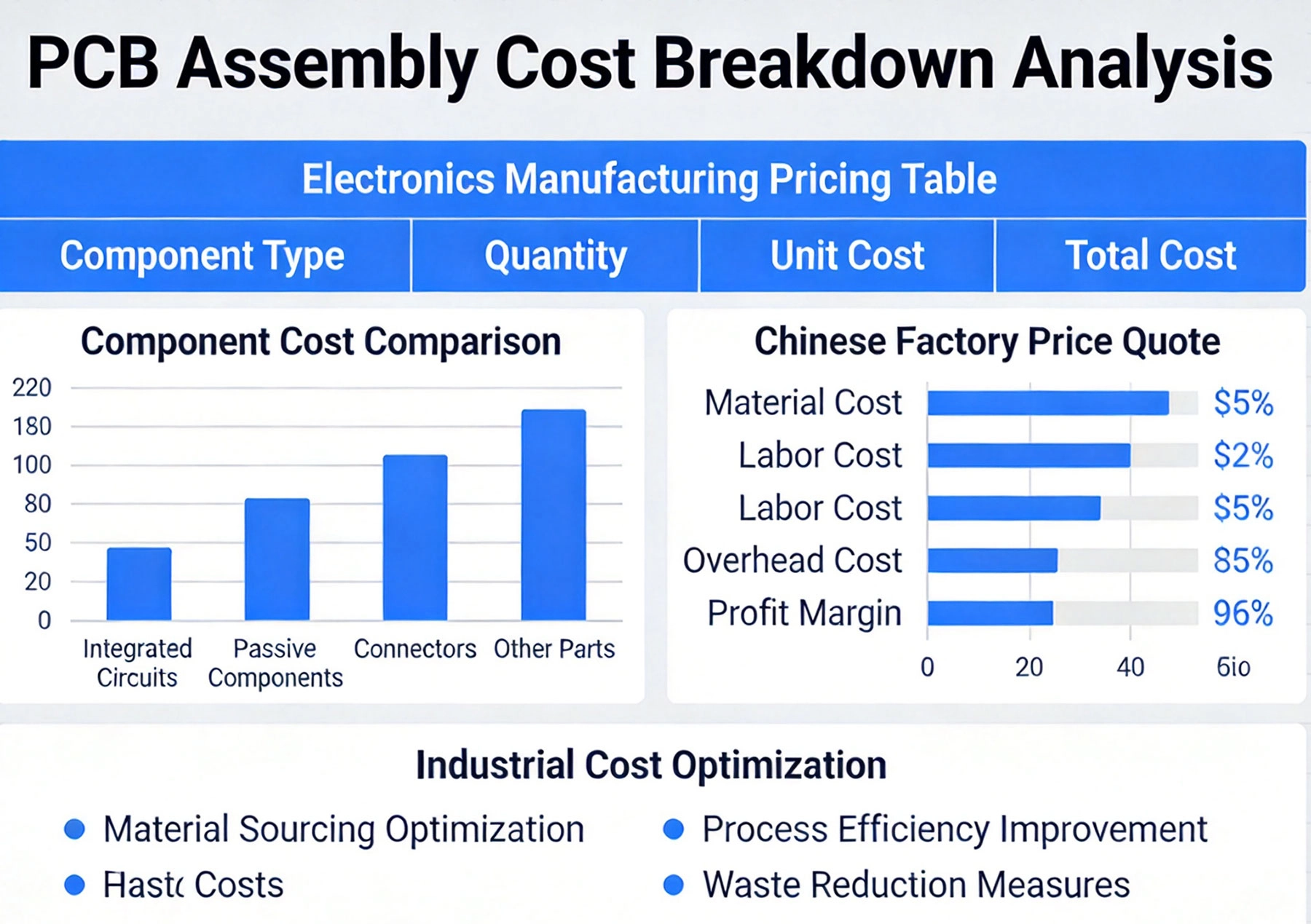
Your Pcb Assembly Quote contains multiple cost layers. Understanding each component helps identify optimization opportunities and spot potential issues in quotes from prospective suppliers.
Components typically represent the largest single cost element in PCB assembly. Active components—microcontrollers, memory chips, sensors, power management ICs—vary wildly in price from $0.01 for simple logic chips to $50+ for complex processors or wireless modules. Passive components (resistors, capacitors, inductors) seem inexpensive individually but add up quickly: a typical consumer product might contain 200-500 passive components at $0.001-0.01 each.
Component pricing depends on several factors. Brand matters significantly—components from major manufacturers (TI, STMicroelectronics, Murata, Samsung) cost 10-30% more than equivalent generics but offer better quality consistency and long-term availability. Package type impacts price—QFN packages cost less than equivalent BGA due to simpler manufacturing requirements. Volume commitment unlocks better pricing: 10,000 unit orders typically receive 15-25% better component pricing than 1,000 unit orders through distributor volume programs.
Despite China's rising wages, labor still represents a meaningful portion of assembly costs. SMT line operators in Shenzhen earn approximately 6,000-8,000 RMB monthly ($850-1,100), while equivalent positions in the US run $3,500-5,000 monthly. This 4-5x difference translates to meaningful assembly cost advantages for labor-intensive operations.
However, labor costs are becoming less significant as automation improves. Modern SMT lines with advanced pick-and-place equipment reduce direct labor content dramatically. A single operator can now manage multiple production lines that would have required 3-4 operators a decade ago. The real labor cost advantage now lies in setup, programming, inspection, and rework—tasks that remain labor-intensive regardless of automation level.
Non-recurring engineering costs cover equipment setup, programming, and tooling. These costs don't scale with volume, making them critical factors for prototype and low-volume orders.
Stencil costs typically run $50-200 depending on material ( stainless steel vs. polyimide) and complexity. Programming charges vary from $50-300 per unique board design, covering Gerber review, pick-and-place programming, and first article setup. Test fixtures—ICT beds, functional test equipment—add $200-1,000 depending on complexity. For a simple 100mm × 100mm board with standard components, expect $200-400 in total NRE costs. Complex boards with BGA components and extensive testing requirements can see NRE costs of $1,000-2,500.
Testing costs vary based on your quality requirements and the complexity of verification needed.
Basic flying probe electrical testing runs $0.10-0.30 per board. In-circuit testing (ICT) with bed-of-nails fixtures costs $0.30-0.80 per board plus $500-2,000 fixture investment. Functional testing—verifying the board actually performs its intended function—varies widely based on test complexity, from $0.50 to $5.00+ per board. X-ray Inspection for BGA joints adds $0.20-0.50 per board. Aoi (Automated Optical Inspection) typically costs $0.15-0.40 per board.
Current market rates for PCB assembly in China vary based on complexity, volume, and requirements. These ranges reflect standard commercial quality; premium quality or specialized requirements may fall outside these bands.
Boards with standard components (0603/0805 passives, SOIC packages, no BGAs) typically quote at $0.025-0.045 per placement. A board with 200 placements would run approximately $5-9 in assembly labor, plus components. Total including components: $15-40 per board depending on component selection. These products dominate the consumer electronics market—things like bluetooth speakers, simple wearables, and basic IoT devices fall into this category.
Products with BGAs, QFNs, fine-pitch components, or 01005 passives command higher pricing. Assembly quotes typically run $0.035-0.065 per placement due to slower placement speeds and higher defect risk. A smartphone-sized board with 800 placements might cost $28-52 in assembly alone. Total with components varies dramatically based on processor, memory, and display requirements—from $50-200 per board for complex consumer devices.
Higher reliability requirements drive costs up. Assembly quotes typically range $0.045-0.080 per placement due to stricter process controls, enhanced inspection, and documentation requirements. Quality certifications (Iso 13485 for medical, Iatf 16949 for automotive) add overhead costs reflected in pricing. First-pass yield requirements exceed 99% compared to 98% for consumer products, requiring more in-process inspection and tighter process control.
Specialized requirements command premium pricing. RF assemblies requiring Controlled Impedance, specialized materials (Rogers, PTFE-based laminates), and careful handling quote at $0.06-0.12 per placement. Assembly in cleanroom environments adds $0.02-0.05 per placement. Total costs often exceed $100 per board even for relatively simple circuits due to specialized requirements.
Beyond basic cost components, several factors influence whether you pay the low end or high end of typical price ranges.
How efficiently your boards fit on manufacturing panels directly impacts your cost. Standard panels measure 18" × 24" or 20" × 24". A 100mm × 100mm board fits 16 per panel in a simple array. But creative Panelization—fitting 24 or 32 boards through clever arrangement—spreads setup costs across more units. Some manufacturers offer pricing breaks at specific panel counts, making optimization worth discussing with your supplier.
Multi-up panels containing multiple different board designs share setup costs. If you're building several related products, consolidating them onto single panels can reduce per-board costs by 10-20%. However, this requires careful coordination of production schedules and quality requirements across products.
Each unique component in your BOM adds procurement and inventory management cost. Boards using 50 unique component types cost more to assemble than equivalent boards using 30 types, even with the same total component count. Standardization—using the same component across multiple locations or products—reduces these overhead costs.
Component sizing impacts assembly cost significantly. 0603 (1608 metric) components are faster to place than 0402 (1005 metric), which is faster than 0201 (0603 metric). Using the largest practical component size reduces placement time and improves first-pass yield. Unless Miniaturization is critical, consider whether 0603 passives might work where 0402 is specified.
Designs that follow manufacturer Dfm guidelines cost less to produce. Common Dfm issues that increase costs include: trace widths below manufacturer minimums requiring special processing, via sizes requiring custom drilling, uneven component distribution causing panel warping, and thermal relief issues causing solder defects.
Requesting Dfm Review before production often identifies cost-reduction opportunities. Our DFM reviews typically find 10-15% Cost Reduction opportunities through Design Optimization. Addressing these issues before production avoids costly respins and ensures smoother production runs.
Volume dramatically impacts per-unit pricing through cost amortization. Single prototypes might cost $500-1,000 in total (including high NRE), while 1,000 units might total $3,000-5,000 (dramatically lower per unit). The break points typically occur at:
Scheduling flexibility unlocks better pricing. Standard lead times of 7-10 days command premium pricing. If you can accept 15-20 day lead times, manufacturers can optimize production scheduling, reducing costs by 5-10%. Rush orders (2-3 day turnaround) typically add 30-50% premium.
Several costs often missing from initial quotes can surprise buyers unfamiliar with manufacturing realities.
Quoted component prices assume current market conditions. Semiconductor shortages, currency fluctuations, and supply disruptions can dramatically change component pricing between quote and production. We've seen component prices swing 30-50% in weeks during shortage periods. Building component price contingencies into your quotes—10-20% buffer—protects against unexpected increases.
First-pass yield never reaches 100%. Even excellent manufacturers experience 1-3% defect rates on initial production runs. These defects require rework—touch-up soldering, component replacement, or in severe cases, board replacement. Rework costs rarely appear in quotes but can add 2-5% to total production costs for typical products.
Getting finished boards from China to your destination involves multiple cost layers. Air freight runs $0.50-2.00 per kg for express services. Ocean freight costs $0.10-0.30 per kg for sea shipments. Customs duties vary by product classification and destination country—typical rates run 0-10% for electronics products. Import VAT applies in some jurisdictions. These costs often exceed 10% of product value for small shipments.
Defective products discovered after shipment require investigation, sorting, and potentially replacement. The cost of a 1% defect rate escaping to customers includes sorting costs ($0.50-2.00 per board), shipping for returns, replacement boards, and potential customer relationship damage. Building quality verification at incoming inspection—spending $0.50-1.00 per board on verification—often costs less than dealing with field failures.
Reducing PCB assembly costs requires systematic approach rather than simply pushing suppliers for lower prices.
Working with fewer, larger suppliers often reduces costs. Each supplier relationship involves overhead—communication, quality monitoring, payment processing. Consolidating to single or dual sourcing typically reduces per-unit costs 5-15% through volume leverage and reduced management overhead. However, this requires confidence in supplier reliability and some risk tolerance for supply concentration.
Design decisions made months before production determine manufacturing costs. Engaging your CM (Contract Manufacturer) during design phase—rather than after design completion—unlocks Cost Reduction opportunities unavailable later. Common DFM improvements that reduce costs include: standardizing component packages, optimizing Panelization, simplifying routing to reduce layer count, and specifying components from supplier stock rather than special orders.
Regular value engineering reviews examine existing products for cost reduction opportunities. Component alternatives might offer 10-30% cost reduction with equivalent performance. Panel redesign might reduce material waste. Test requirement review might eliminate unnecessary testing. Scheduling optimization might reduce expediting fees. We conduct quarterly value engineering reviews for clients, typically identifying 3-8% annual cost reduction opportunities.
Component shortages drive price increases. Building strategic inventory of long-lead-time or shortage-prone components—typically 4-8 weeks of forward demand—protects against price increases and shortages while adding modest carrying cost. This approach works best for components representing significant cost (>5% of total BOM) or components with known supply constraints.
Price differences reflect multiple variables beyond basic cost structures. Equipment capability differences—newer high-speed lines vs. older equipment—affect efficiency and quality. Quality investment variations—inspection equipment, process controls, certification costs—impact pricing. Geographic location within China affects labor and overhead costs. Supplier business models—some target premium quality markets, others compete on price. Component sourcing approaches—authorized distributor sourcing vs. broker markets—create cost and risk differences. The lowest price rarely represents the best value when quality, reliability, and supply chain risk are considered.
Multiple strategies reduce costs while maintaining quality. Design Optimization through Dfm Review typically identifies 10-15% cost reduction opportunities. Component standardization reduces procurement and inventory costs. Volume consolidation amortizes setup costs across more units. Scheduling flexibility unlocks standard pricing instead of rush premiums. Long-term relationships with committed volumes enable better pricing through supplier investment in your program. Transparent cost discussions—sharing target costs and working with suppliers on achievement—often unlock collaboration on cost reduction rather than adversarial price negotiation.
Payment terms evolve through buyer-supplier relationships. Initial orders typically require prepayment or payment with shipment (30-50% deposit, balance upon shipment). Established relationships (6-12 months, proven quality record) may qualify for net 30 payment terms. Long-term strategic partners might negotiate net 45-60 terms. Payment methods include wire transfer (standard), letter of credit for larger orders providing mutual protection, and some suppliers accept PayPal for small orders with fee absorption. We offer flexible terms scaled to relationship maturity and order volume.
Competitive verification requires context. Quote the same design with 2-3 different manufacturers and compare line-item pricing. Use industry benchmarks—IPC publishes periodic compensation studies with manufacturing cost data. Request cost breakdowns rather than lump quotes to compare component margins, labor rates, and overhead allocations. Engage third-party cost audits for significant programs. Build cost models using publicly available data on labor rates, material costs, and equipment amortization. Prices 20%+ below market averages warrant investigation—either you're getting exceptional value or facing hidden risks.
Several trends shape 2024 pricing. Labor costs continue rising 5-8% annually, though automation offsets some impact. Component markets show mixed signals—some categories remain tight while others see softening. Energy costs fluctuated with geopolitical factors, impacting manufacturing overhead. The shift toward regionalization—some buyers diversifying to Vietnam, Thailand, or Mexico—creates both competitive pressure and potential supply chain complexity. Overall, we expect 3-6% nominal cost increases for most products, though specific situations may vary significantly based on component mix, technology requirements, and supplier relationships.
PCB assembly pricing in China involves far more than comparing quoted per-placement rates. Understanding cost components, recognizing hidden costs, and building strategic supplier relationships delivers better outcomes than simply chasing lowest prices.
The lowest quoted price often carries hidden costs—quality risks, supply chain vulnerabilities, communication challenges. The highest quoted price might include investments in capabilities that prevent expensive problems later. Smart sourcing means understanding what you're actually paying for and making informed trade-offs based on your specific requirements and risk tolerance.
Ready to optimize your PCB assembly spend with transparent, competitive pricing? Share your design files for a comprehensive Cost Analysis including detailed breakdowns, optimization recommendations, and realistic pricing for your volume and requirements. Our team provides complete transparency into cost components, helping you make informed sourcing decisions that balance cost, quality, and supply chain risk.
How to Reduce Your PCB Manufacturing Costs Without Sacrificing QualityJuly/08/2026
How Automated Optical Inspection (AOI) Ensures SMT QualityAugust/15/2026
Thru-Hole vs. SMT: Choosing the Right Assembly Technology for Your PCBJuly/10/2026
The Complete Step-by-Step Process ExplainedJune/05/2026

Understanding PCB Assembly Prices in China: What Factors Influence Cost?June/10/2026
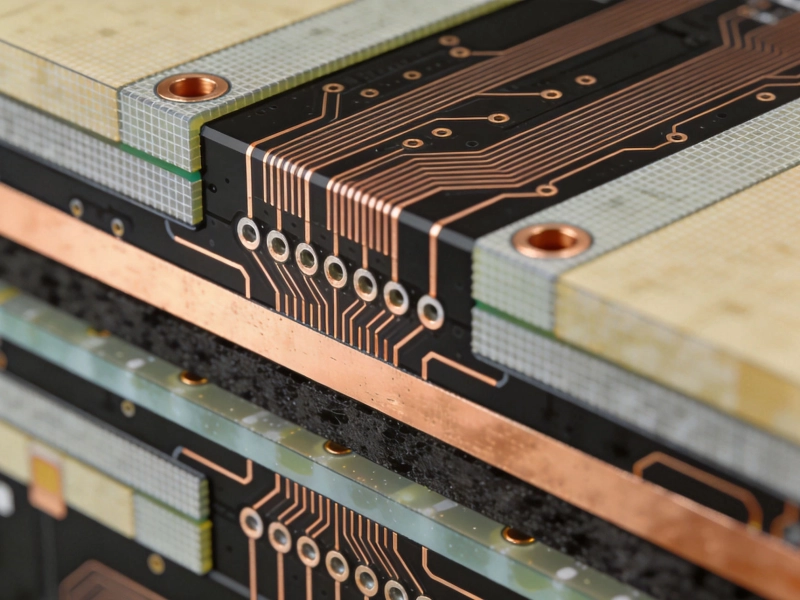
What is a Multilayer PCB? A Comprehensive Guide for EngineersJuly/02/2026
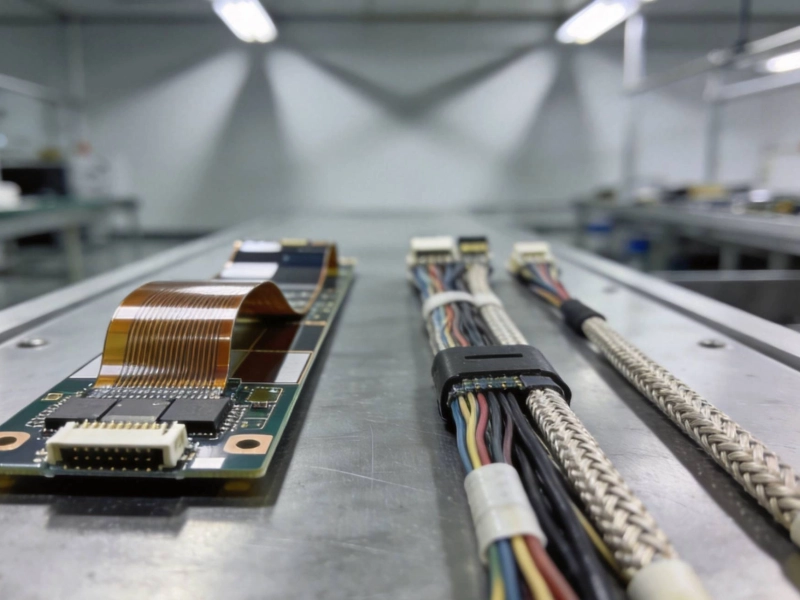
Cost-Benefit Analysis of Rigid-Flex PCBs vs. Traditional Cable AssembliesSeptember/14/2026

Rigid-Flex PCB Design Guide: Bridging the Gap Between Rigid and FlexJuly/03/2026