Open Nav

High-density Interconnect (HDI) printed circuit boards have revolutionized electronics by enabling unprecedented component density and signal routing complexity. At the heart of Hdi Technology lies the microvia—tiny holes that connect different board layers with diameters measured in fractions of a millimeter. Creating these Microvias requires drilling capabilities far beyond what traditional mechanical drilling can achieve, driving the adoption of Laser Drilling as the primary method for HDI fabrication. Yet mechanical drilling remains essential for many PCB applications, creating a manufacturing landscape where both technologies coexist, each serving specific purposes.
Understanding the differences between Laser Drilling and mechanical drilling—their capabilities, limitations, costs, and optimal applications—enables engineers and procurement professionals to make informed decisions about Pcb Manufacturing approaches. This article examines both technologies through the lens of HDI manufacturing requirements, helping you navigate the drilling technology landscape effectively.
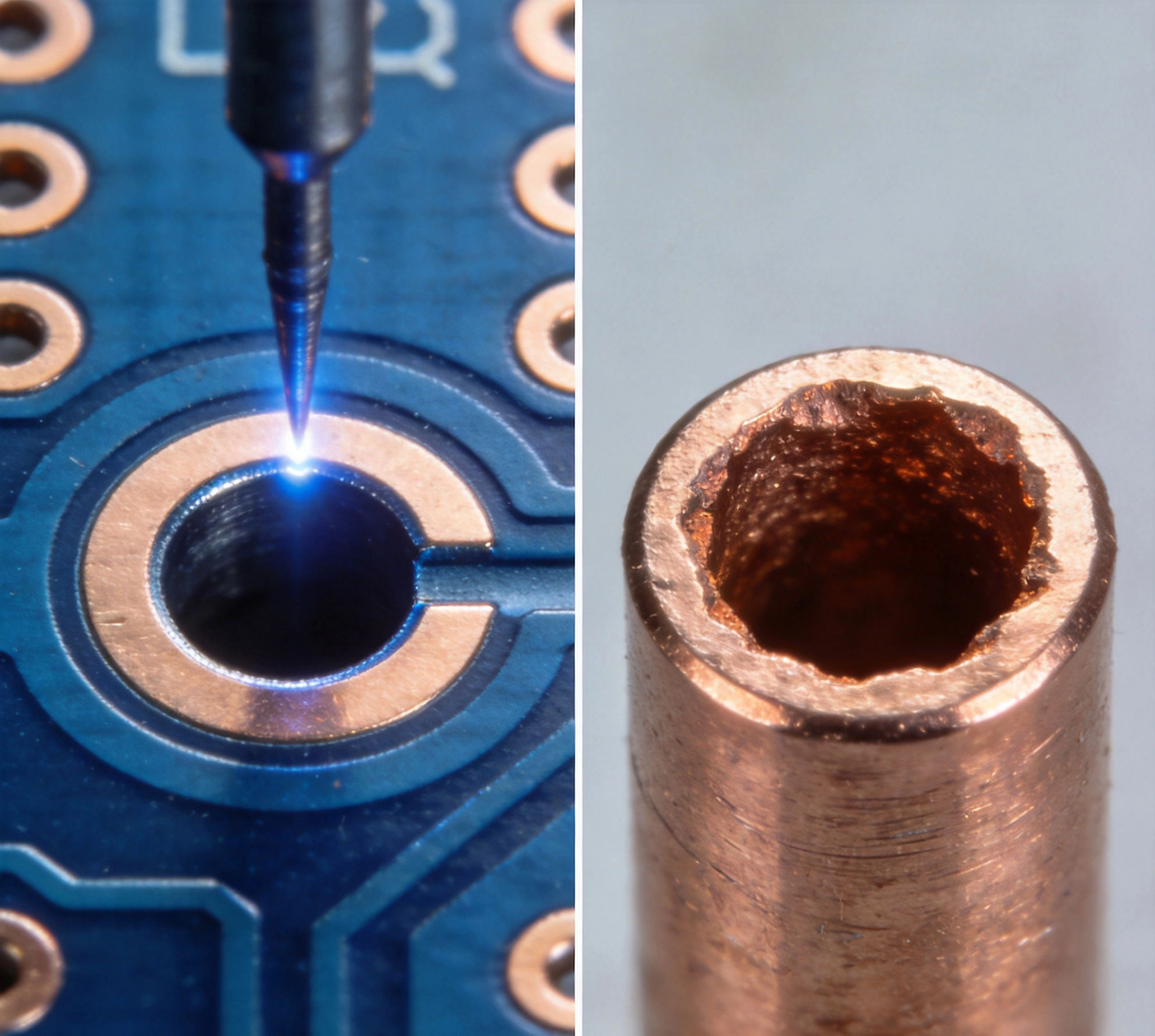
Before comparing capabilities, understanding the fundamental operating principles of each drilling method provides context for their respective strengths and limitations.
Mechanical Drilling
Mechanical drilling uses rotating drill bits—typically carbide or coated high-speed steel—to physically remove material from the PCB substrate. The drill spindle rotates at high speed (typically 80,000 to 300,000 RPM for PCB applications) while the drill bit advances into the material, cutting through glass fiber, epoxy resin, and copper layers.
The drilling process generates heat through friction, requiring careful control of spindle speed, feed rate, and peck depth to prevent drill bit wear, material melting, or hole quality degradation. Drill bits have finite lifespans and must be replaced periodically as they dull or wear.
Mechanical drilling is a contact process—the drill bit physically touches and cuts the material. This contact creates mechanical forces on the workpiece and requires workpiece fixturing to prevent movement during drilling. The process produces cylindrical holes with straight walls determined by the drill bit diameter.
Laser Drilling
Laser drilling uses concentrated light energy to remove material through ablation—the vaporization or decomposition of material exposed to intense laser radiation. Different laser types (CO2, UV, excimer) use different wavelengths and energy delivery mechanisms to achieve material removal.
CO2 lasers (10.6 micrometer wavelength) are absorbed by organic materials (epoxy, polyimide) but reflected by copper, making them suitable for drilling Blind Vias in dielectric layers. UV lasers (355nm or 266nm wavelength) are absorbed by copper and can drill through copper-clad materials.
Laser drilling is a non-contact process—the laser beam removes material without physical contact. This eliminates mechanical forces on the workpiece and enables drilling of thin or delicate materials that mechanical drilling might damage. The process creates holes with profiles determined by laser parameters—typically tapered for CO2 drilling, more vertical for UV drilling.
The precision capabilities of drilling technologies fundamentally determine their suitability for HDI applications where microvia diameters measure 100 micrometers or less.
Mechanical Drilling Limits
Mechanical drilling faces fundamental physical limits on minimum hole size. Drill bit diameter, bit strength, and material behavior constrain how small mechanical holes can be. Standard PCB mechanical drilling achieves minimum hole diameters of approximately 100 micrometers (0.10mm), with specialized high-precision equipment reaching perhaps 80 micrometers under ideal conditions.
Beyond these limits, drill bits become too fragile to survive the drilling process, or the material behavior changes—drill bit flexure, material melting, and hole wall quality degradation make smaller holes impractical. While research continues to push mechanical drilling limits, current technology cannot reliably produce the sub-100-micrometer holes that HDI designs require.
Positional accuracy for mechanical drilling typically achieves ±25 micrometers or better with modern CNC drilling machines. This accuracy is adequate for most through-hole and larger Blind Via applications but may be marginal for the densest HDI designs with fine-pitch Microvias.
Laser Drilling Capabilities
Laser drilling achieves hole diameters far smaller than mechanical drilling—routinely producing 50-micrometer holes and capable of reaching 25 micrometers or smaller for specialized applications. This capability directly enables Hdi Technology, where microvia diameters of 75 micrometers or less are common.
Positional accuracy for laser drilling typically exceeds mechanical drilling, achieving ±10 to ±15 micrometers depending on equipment and process optimization. This improved accuracy enables tighter spacing between microvias and denser routing that HDI designs demand.
Hole profile control through laser parameter optimization allows tailored geometries for specific applications. Tapered profiles may be desirable for plating coverage; vertical profiles may be required for stacked microvia structures. Laser drilling's parameter flexibility enables these profile variations.
Beyond technical capabilities, manufacturing economics determine technology selection for production applications.
Mechanical Drilling Speed
Mechanical drilling achieves high throughput for standard through-hole applications. Modern multi-spindle drilling machines can drill thousands of holes per minute, with each spindle processing a different hole simultaneously. For boards with many through-holes, mechanical drilling provides cost-effective high-volume production.
However, throughput decreases as hole sizes decrease. Small-diameter drills require slower feed rates and more frequent peck cycles to clear debris and prevent bit breakage. The time required to change worn drill bits also reduces effective throughput. For HDI microvias, mechanical drilling throughput would be unacceptably low even if the technology could achieve required hole sizes.
Laser Drilling Throughput
Laser drilling throughput depends on laser type, hole size, material thickness, and required quality. CO2 lasers drilling Blind Vias in dielectric layers can achieve drilling speeds of 200 to 1000 holes per second—substantially faster than mechanical drilling for comparable applications. UV lasers, drilling through copper, operate more slowly—50 to 300 holes per second—but still achieve adequate throughput for most HDI production.
The non-contact nature of laser drilling eliminates tool changes and associated downtime. Laser systems can drill continuously without the bit replacement interruptions that mechanical drilling requires. This continuous operation improves equipment utilization and effective throughput.
Cost Structure Comparison
Mechanical drilling equipment costs are lower than laser drilling systems—a high-precision mechanical drill machine might cost $50,000 to $200,000, while laser drilling systems range from $500,000 to $3 million depending on type and capability. This capital cost difference makes mechanical drilling more accessible for smaller manufacturers or lower-volume applications.
Operating costs also differ. Mechanical drilling consumes drill bits that require regular replacement—costs that accumulate across production volume. Laser drilling consumes electrical power and requires periodic maintenance but doesn't have the consumable tool costs that mechanical drilling incurs.
For high-volume HDI production, laser drilling's higher capital cost amortizes across large production volumes, and the higher throughput reduces per-hole processing cost. For standard through-hole applications where mechanical drilling achieves adequate performance, the lower equipment cost of mechanical drilling provides better economics.
Different drilling technologies interact differently with Pcb Materials, affecting hole quality and process selection.
Mechanical Drilling Material Interaction
Mechanical drilling performs well on standard FR-4 materials, cutting through glass fiber and epoxy with predictable results. The process generates heat that must be managed to prevent material degradation—smearing, burring, or delamination at hole walls.
Material stack-up complexity affects mechanical drilling. Multilayer boards with many layers require longer drill bits that are more susceptible to deflection and breakage. High-aspect-ratio holes (deep holes with small diameters) challenge mechanical drilling due to bit flexibility and chip evacuation difficulties.
Specialized materials—high-frequency laminates, flexible circuits, or metal-core boards—may require modified drilling parameters or tooling. PTFE-based materials, in particular, present challenges due to their soft, gummy consistency that can cause drill bit loading and poor hole quality.
Laser Drilling Material Considerations
Laser drilling material interaction depends on laser wavelength and material optical properties. CO2 lasers are absorbed by organic materials but reflected by copper, limiting them to drilling dielectric layers only. UV lasers are absorbed by both copper and dielectric materials, enabling drilling through copper-clad laminates.
The glass reinforcement in standard FR-4 creates challenges for CO2 laser drilling—the glass absorbs laser energy differently than the epoxy matrix, potentially causing inconsistent hole quality. Laser-rated FR-4 formulations with modified glass content provide more uniform drilling characteristics.
High-frequency materials, polyimide films, and other specialized substrates respond differently to laser energy than standard FR-4. Process parameters must be optimized for each material type to achieve consistent results. Some materials—particularly PTFE-based substrates—may require specialized laser approaches or pre-treatment.
The quality of drilled holes directly affects board reliability, particularly for the plated-through holes and microvias that provide interconnection between layers.
Mechanical Drilling Hole Quality
Mechanical drilling produces cylindrical holes with straight walls—ideal for through-hole plating where uniform copper coverage is desired. However, the cutting action can create defects including burrs at hole entrances, nail-heading (copper deformation at hole edges), and fiber protrusion from woven glass reinforcement.
Desmear processes following mechanical drilling remove resin smear and debris from hole walls, preparing them for electroless copper deposition. Proper desmear is essential for reliable plating adhesion and electrical connectivity.
High-aspect-ratio holes (depth-to-diameter ratios above 10:1) present particular challenges for mechanical drilling. Bit deflection, chip evacuation, and heat management become increasingly difficult as aspect ratios increase. HDI applications with deep microvias may exceed practical mechanical drilling limits.
Laser Drilling Hole Quality
Laser drilling produces holes with different characteristics than mechanical drilling. CO2 laser drilling typically creates tapered holes—wider at the surface, narrower at the bottom—with the taper angle determined by laser parameters and material properties. UV laser drilling achieves more vertical walls but may still show some taper.
The laser ablation process can create heat-affected zones (HAZ) near hole walls where material properties may be modified by thermal exposure. HAZ extent depends on laser parameters—pulse energy, duration, and overlap. Excessive HAZ can affect dielectric properties and long-term reliability.
Laser-drilled holes require desmear processing similar to mechanically drilled holes, though the mechanisms differ. Laser drilling may create carbonized residues from material decomposition that require removal before plating. Process optimization minimizes these residues and ensures clean hole walls for reliable plating.
The choice between laser drilling and mechanical drilling depends on specific application requirements—hole size, volume, material, and cost constraints.
Mechanical Drilling Applications
Mechanical drilling remains the preferred choice for standard through-hole applications where hole sizes exceed 0.20mm (200 micrometers). The lower equipment cost, established process knowledge, and high throughput for standard holes make mechanical drilling economically advantageous for these applications.
Through-holes for connectors, mounting hardware, and power components typically use mechanical drilling. These holes require diameters larger than laser drilling's sweet spot, and the straight-wall geometry that mechanical drilling produces is ideal for through-hole plating.
Prototyping and low-volume production may favor mechanical drilling even for smaller holes when the capital investment for laser equipment cannot be justified. Quick-turn prototype shops often use mechanical drilling exclusively, accepting the larger minimum hole sizes that result.
Laser Drilling Applications
Laser drilling is essential for HDI microvia applications where hole sizes fall below 0.15mm (150 micrometers). The technology's capability to produce holes at 75 micrometers, 50 micrometers, or smaller directly enables the component density and routing complexity that HDI designs require.
Blind Via formation in build-up layers is ideally suited to CO2 laser drilling. The laser ablates dielectric material to create vias connecting surface layers to underlying layers, providing the vertical interconnection that HDI stack-ups need.
Via-in-pad applications, where vias are placed directly in component pads, benefit from laser drilling's precision and small hole capability. These structures are common in high-density BGA fanout designs where routing channels are severely constrained.
Flexible and rigid-Flex Circuits often use laser drilling due to the delicate materials involved. The non-contact nature of laser processing avoids mechanical damage that might occur with drill bit contact.
Many HDI boards benefit from hybrid drilling approaches that use both mechanical and laser drilling for different features.
Sequential Drilling Operations
Complex HDI boards may require both through-holes (mechanically drilled) and microvias (laser drilled). The manufacturing sequence must coordinate these operations—mechanical drilling of through-holes typically occurs before laser drilling of microvias to avoid damaging delicate microvia structures.
Registration between mechanically drilled and laser-drilled features requires careful process control. Layer-to-layer alignment must account for cumulative tolerances from both drilling operations to ensure that vias align properly with capture pads.
Cost Optimization
Using mechanical drilling where it is adequate and laser drilling only where necessary optimizes manufacturing cost. Through-holes, mounting holes, and larger vias can use mechanical drilling, while only the smallest microvias require laser processing.
Manufacturing partners with both capabilities can optimize drilling sequences for cost and quality, applying each technology where it provides the best value.
Both mechanical and laser drilling technologies continue evolving, pushing capability boundaries and expanding application spaces.
Mechanical Drilling Advances
Research into ultra-small drill bits, advanced coatings, and high-speed spindles continues extending mechanical drilling capabilities. While fundamental physical limits constrain how far mechanical drilling can extend into microvia territory, incremental improvements maintain mechanical drilling's competitiveness for standard applications.
Improved drill bit materials and geometries reduce wear and breakage, improving reliability and reducing consumable costs. Enhanced CNC control and vision systems improve positional accuracy and registration capabilities.
Laser Technology Evolution
Laser drilling technology continues advancing with higher power, better beam quality, and improved process control. Femtosecond and picosecond pulsed lasers offer ultra-precise material removal with minimal heat-affected zones, potentially improving microvia quality for the most demanding applications.
Multi-wavelength laser systems combine different laser types to optimize drilling for specific material stacks. These systems can tailor energy delivery to the specific materials being processed, improving hole quality and process flexibility.
Throughput improvements through higher repetition rates and parallel processing increase laser drilling productivity, reducing the cost premium compared to mechanical drilling.
Laser drilling and mechanical drilling serve complementary roles in modern Pcb Manufacturing. Mechanical drilling continues to dominate standard through-hole applications with its lower cost and established reliability. Laser drilling enables HDI technology with capabilities that mechanical drilling cannot match. Understanding the strengths, limitations, and optimal applications of each technology allows manufacturers and designers to make informed decisions that balance capability, cost, and quality. As electronics continue miniaturizing and HDI adoption expands, laser drilling's role grows, but mechanical drilling remains essential for the foreseeable future—a technology partnership that serves the full spectrum of PCB manufacturing requirements.
Heavy Copper PCB Etching: Challenges, Tolerances, and Precision SolutionsSeptember/10/2026
Preparing Your Gerber Files for a Smooth China PCB Fabrication ProcessSeptember/18/2026
China vs. Local PCB Suppliers: Analyzing Cost, Quality, and Lead TimeJuly/22/2026
Understanding Surface Finishes: ENIG, HASL, OSP, and Immersion SilverJuly/21/2026
PCB Fabrication China: A Complete Guide for Global BuyersMay/18/2026
Bridging the Gap: Moving from PCB Prototype to Mass ProductionOctober/09/2026
IoT Devices and the Demand for Compact, Low-Cost PCB PrototypesJuly/31/2026
PCB Assembly Price China: A Complete Cost Guide for 2024May/18/2026