Open Nav

When a smartphone fails to boot or a medical device shuts down unexpectedly, the root cause often traces back to a single manufacturing stage: Multilayer Pcb lamination. This critical process bonds multiple layers of conductive and insulating materials under precise heat and pressure conditions. A minor deviation during lamination can create delamination, voids, or misalignment—defects that compromise the entire electronic assembly.
Quality Control in Multilayer Pcb lamination isn't a checkpoint at the end of production. It's an integrated discipline that spans material inspection, process monitoring, and end-product testing. Manufacturers who master this balance consistently deliver boards that perform reliably across automotive, aerospace, consumer electronics, and healthcare applications.
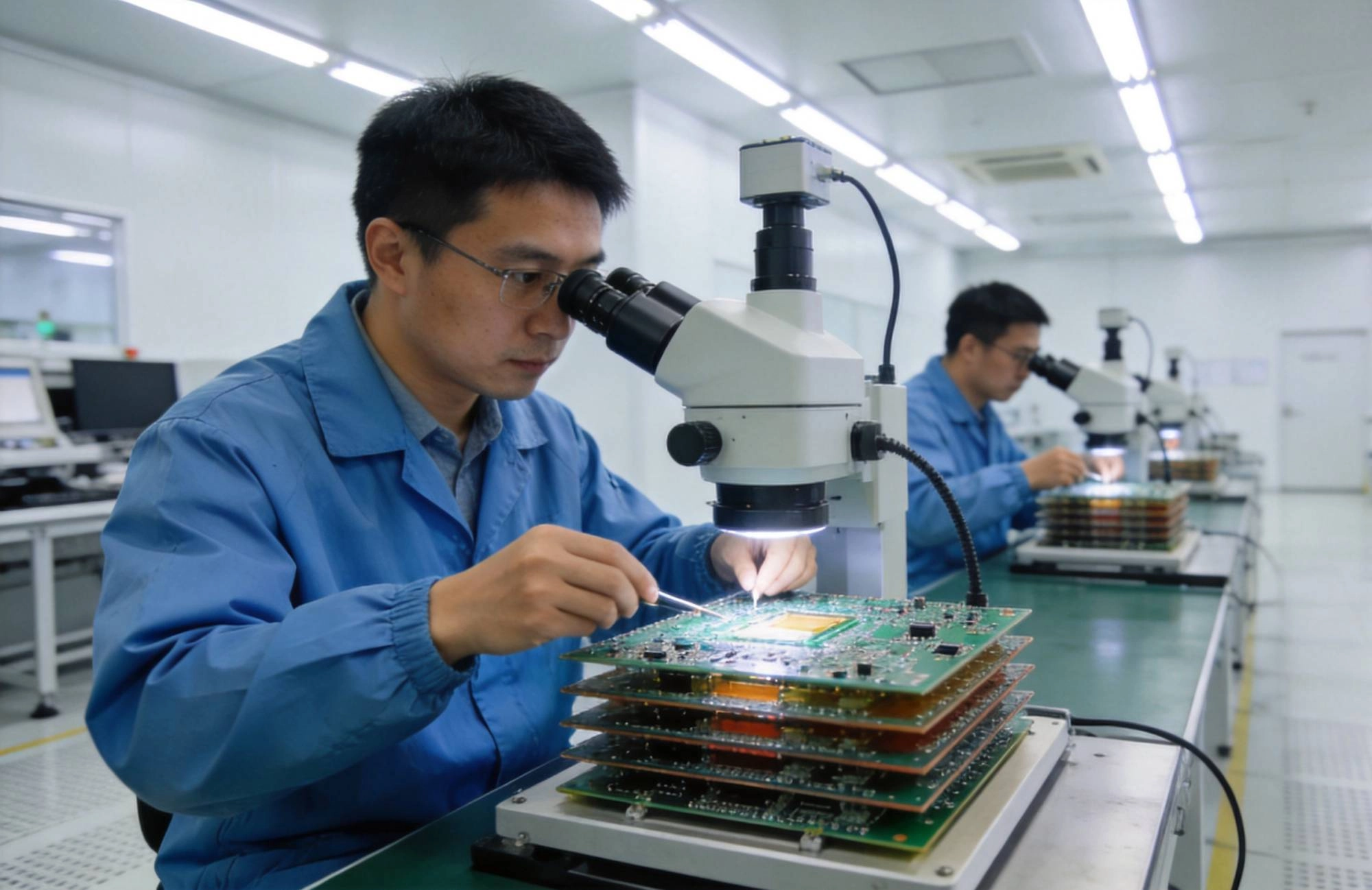
Modern electronic devices demand increasingly complex PCB architectures. Eight-layer, twelve-layer, and even ultra-High-density Interconnect (HDI) boards with 20 or more layers are now standard in compact smartphones and advanced computing systems. Each additional layer multiplies the opportunities for lamination-related defects.
The consequences extend beyond device failure. Recalls, warranty claims, and reputational damage accumulate quickly when quality slips. In safety-critical applications like automotive engine control units or implantable medical devices, lamination defects can create catastrophic outcomes. That's why leading manufacturers treat multilayer PCB lamination Quality Control as a core competency rather than an afterthought.
Quality-conscious manufacturers align their lamination processes with international standards including IPC-A-600 for board acceptability, IPC-6012 for rigid board qualification, and Iatf 16949 for automotive applications. These frameworks establish baseline requirements for laminate integrity, conductor spacing, and environmental performance that directly influence lamination parameters and inspection protocols.
Quality control begins before lamination even starts. Prepreg sheets—the fiberglass cloth pre-impregnated with partially cured resin—must meet strict specifications for thickness uniformity, resin content, and flow characteristics. Manufacturers typically verify prepreg batch numbers against certificates of conformance and perform random sampling for laboratory analysis.
Inner layer boards undergo optical inspection before lamination. Automated Optical Inspection (Aoi) systems scan for conductor defects, pattern irregularities, and dimensional inaccuracies. Any board failing inspection returns to rework rather than proceeding to lamination, where defects would become trapped and unrepairable.
The lamination press itself represents the heart of the quality control process. Modern hydraulic or vacuum presses maintain precise control over three critical parameters:
Data loggers record every pressure cycle, temperature reading, and vacuum level throughout each press run. This documentation creates traceability records that prove invaluable during quality audits and failure analysis.
Resin voids and delamination between layers represent the most common lamination defects. These occur when trapped air, moisture, or contamination prevents proper resin bonding. Detection methods include:
Ultrasonic Scanning (C-SAM): This non-destructive technique sends high-frequency sound waves through the laminated board. Voids and delamination reflect the sound differently than properly bonded areas, creating distinct signatures on the imaging system. C-SAM inspection catches internal defects that remain invisible to optical examination.
Thermal Stress Testing: Sample boards undergo accelerated thermal cycling to expose latent lamination weaknesses. Boards that delaminate during testing trigger process investigation and corrective action.
Lamination can introduce dimensional changes through resin flow and thermal expansion. Quality control teams verify finished panel dimensions against specifications using coordinate measuring machines (CMM) or laser scanning systems. Bow and twist measurements ensure boards will seat properly during assembly and operate reliably in end-use environments.
As multilayer PCBs add more internal layers, traditional visual inspection becomes impossible for buried conductors and vias. X-ray Inspection systems penetrate the board structure to reveal internal layer alignment, barrel integrity in plated through-holes, and void formation around Buried Vias. This capability proves essential for high-layer-count boards where defects deeper than the third layer would otherwise escape detection.
Leading manufacturers integrate machine learning algorithms with their inspection systems. These systems learn from thousands of inspected boards to classify defects with increasing accuracy, flagging potential issues for human review while allowing compliant boards to flow through production without delay.
Effective quality control requires more than individual inspection steps. Manufacturers track process capability using statistical methods like Cpk (process capability index) for critical lamination parameters. A Cpk value above 1.33 indicates a process operating with adequate margin above specification limits, while values below 1.0 signal processes requiring immediate corrective action.
Regular calibration of presses, sensors, and inspection equipment maintains measurement accuracy over time. Many manufacturers implement SPC (Statistical Process Control) charts that alert operators when parameter trends approach control limits, enabling proactive intervention before out-of-specification boards are produced.
When defects escape detection and reach customers, formal root cause analysis processes activate. Fishbone diagrams, 5-Why analysis, and Pareto charts help teams identify systemic causes rather than isolated incidents. Corrective actions might include press maintenance, prepreg handling procedure updates, or operator training enhancements.
Modern lamination quality control also addresses environmental performance. Boards must withstand thermal cycling, humidity exposure, and vibration throughout their service life. Quality teams validate these characteristics through accelerated life testing that simulates years of real-world stress in compressed timeframes.
Lead-freeRoHS compliance has added complexity to lamination quality control. Lead-free solder assembly requires higher peak temperatures, demanding laminates with improved thermal stability. Quality processes must account for these additional thermal stresses during both assembly and end-use operation.
When you partner with a manufacturer that prioritizes multilayer PCB lamination quality control, you gain predictable delivery schedules, reduced field failure rates, and technical documentation that simplifies regulatory compliance. Every inspection checkpoint, every recorded parameter, and every tested sample represents a commitment to board reliability that protects your product reputation.
Our approach combines rigorous process control with continuous improvement philosophy. We invest in inspection technology, maintain rigorous training programs, and document every aspect of our lamination process. This foundation allows us to scale from prototype quantities to high-volume production without sacrificing the quality that complex multilayer designs demand.
Delamination typically results from moisture contamination in prepreg materials, insufficient bonding pressure, improper cure temperatures, or contamination on inner layer surfaces. Strict material handling protocols and process parameter monitoring prevent most delamination issues.
X-ray Inspection reveals layer-to-layer registration accuracy. Additionally, test coupons embedded in production panels can be cross-sectioned to measure alignment under magnification. Some manufacturers use Laser Drilling targets that allow post-lamination verification of layer registration.
Industry standards typically specify void content below 5% for military and aerospace applications, while commercial standards generally accept void content below 10% for non-critical applications. IPC guidelines provide specific acceptance criteria based on board type and application.
Press temperature sensors require calibration every six months minimum, while pressure transducers typically need annual calibration. However, many quality-focused manufacturers calibrate quarterly to maintain tighter process control and reduce measurement uncertainty.
Yes, quality documentation packages typically include material certificates of conformance, process parameter logs, inspection records, and certificates of analysis for critical testing. Many manufacturers offer quality data reports tailored to specific customer requirements.
Quality control in multilayer PCB lamination demands systematic attention across material selection, process control, inspection technology, and continuous improvement. Manufacturers who invest in these capabilities deliver boards that perform reliably in demanding applications while reducing total cost through fewer field failures and warranty claims.
The complexity of modern multilayer designs makes quality control increasingly critical. Partner with manufacturers who treat lamination quality control as a core competency rather than a compliance checkbox, and you'll gain the confidence that comes from knowing every layer in your PCB has been properly bonded and verified.

Behind the Scenes: A Tour of Our State-of-the-Art PCB Factory in ChinaMay/19/2026
Microvias vs. Through-Holes: Choosing the Right Tech for Your Multilayer BoardAugust/06/2026
What Are Multilayer PCBs? A Complete Guide from ChinaMay/18/2026
Durability Requirements for Industrial IoT PCBs: Ensuring Reliability in Harsh EnvironmentsSeptember/03/2026

Understanding HDI PCB Stack-ups: Best Practices for High-Density DesignsJuly/18/2026
How to Design High-Layer Count PCBs (20+ Layers) for Complex ElectronicsSeptember/08/2026

Sourcing Metal Core PCBs for Automotive LED HeadlightsJuly/25/2026
What is a Multilayer PCB? A Comprehensive Guide for EngineersJuly/02/2026