Open Nav

Modern vehicles rely on Flexible Printed Circuit Boards (FPCs) to power advanced sensors, infotainment displays, and comfort systems. Unlike traditional rigid PCBs, flexible circuits bend and twist to fit tight spaces, reducing weight and improving reliability in demanding automotive environments. This article explores how FPCs enable automotive innovations while meeting strict industry standards.
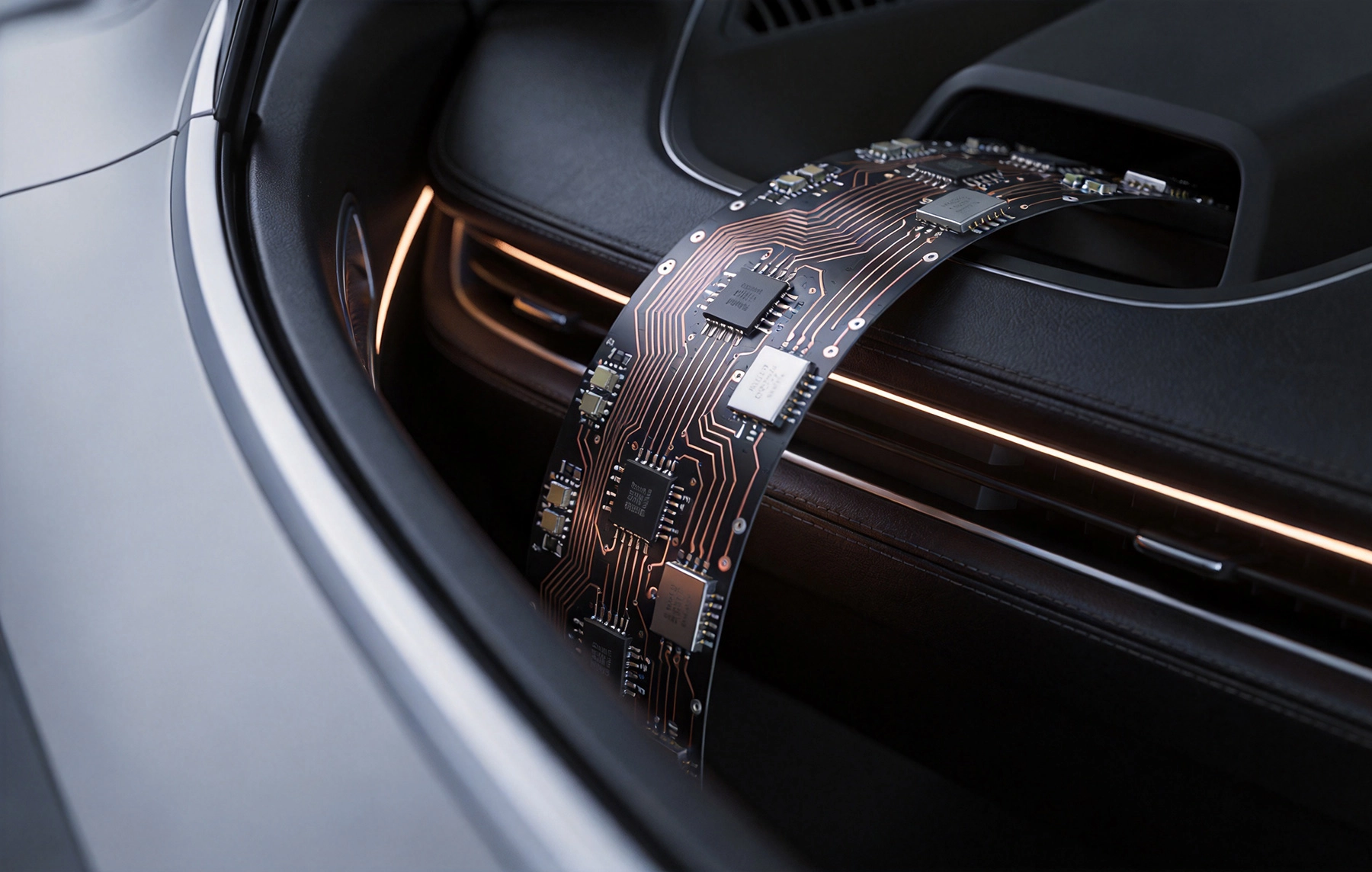
Automotive manufacturers face three critical challenges: space constraints, vibration resistance, and Signal Integrity. Flexible PCBs address all three by conforming to irregular shapes, absorbing mechanical stress, and reducing interconnect failures. According to IPC-6013 Class 3 standards, automotive FPCs must withstand temperature extremes (-40°C to +125°C), humidity, and continuous vibration without performance degradation.
Lightweight construction is another advantage. Electric vehicles (EVs) demand every gram saved to maximize range. FPCs replace bulky wire harnesses in dashboard electronics, reducing weight by up to 30% while simplifying assembly. This weight reduction translates directly to improved fuel efficiency or extended EV battery life.
Modern cars integrate hundreds of sensors for safety, navigation, and performance monitoring. Flexible PCBs enable these sensors to operate in confined areas where rigid boards cannot fit.
ADAS sensors—including cameras, LiDAR, radar, and ultrasonic sensors—depend on FPCs for reliable interconnects. For example, camera modules in rearview and side-mirror assemblies use flexible circuits to route high-speed data through moving parts. The FPC's Bend Radius (minimum 6× material thickness) prevents signal loss during mirror adjustments while maintaining impedance control for differential signaling.
Temperature, humidity, and air quality sensors positioned throughout the vehicle utilize FPCs for compact packaging. In HVAC ductwork, flexible circuits enable multi-zone climate control by distributing sensor data without obstructing airflow. Polyimide-based FPCs with PTFE coating resist moisture and chemical exposure, ensuring long-term reliability in harsh under-hood environments.
Center stack displays, instrument clusters, and head-up displays (HUDs) rely on FPCs for high-speed signal transmission and space-efficient designs.
Modern automotive displays feature curved surfaces for ergonomic design. Flexible PCBs conform to display contours, connecting touch controllers, LED backlights, and display drivers without rigid connectors. This eliminates bulky ribbon cables and reduces assembly complexity. For example, a 12.3-inch curved display may use 4-6 layer FPCs with Controlled Impedance (100Ω ±10%) to support high-resolution video transmission at 60Hz refresh rates.
HUDs project critical driving information onto the windshield, requiring precision optics and electronics. Flexible circuits route power and data to miniature projectors positioned in tight dashboard compartments. The FPC's thin profile (0.1mm typical) allows compact HUD designs while maintaining Thermal Dissipation for high-brightness LEDs.
FPCs power numerous comfort features, from seat heating and ventilation to smart key systems and ambient lighting.
Power seats with heating, ventilation, and massage functions use FPCs embedded in seat foam. These flexible circuits distribute heating elements, temperature sensors, and motor controllers across contoured surfaces without adding bulk. The FPC's flexibility accommodates seat adjustments while maintaining electrical connections through repeated compression cycles.
Interior lighting systems—including door handle illumination, dashboard accents, and console lighting—use flexible circuits for uniform LED distribution. FPCs enable complex lighting patterns with individually addressable LEDs controlled via LIN or CAN bus protocols. The thin, bendable nature of FPCs allows seamless integration into interior trim pieces without visible wiring.
Automotive-grade FPCs must meet stringent quality and reliability standards beyond typical consumer electronics.
Polyimide substrates (e.g., Kapton) dominate automotive FPCs due to thermal stability and chemical resistance. Adhesiveless constructions with rolled annealed copper foils provide superior flexibility and resistance to delamination. For high-frequency applications (e.g., 5G connectivity), low-loss laminates such as Rogers RO3003 minimize signal attenuation while maintaining flexibility.
Automotive Fpc designs prioritize reliability over cost. Minimum trace/space widths of 4mil/4mil balance manufacturability with current capacity. Staggered vias and reinforced tear stops prevent damage during assembly. Impedance-controlled traces require precise stack-up definitions, typically symmetric constructions with dielectric thicknesses controlled to ±10% tolerance.
Automotive FPCs undergo extensive testing including:
Electrical testing includes continuity, insulation resistance (>100MΩ), and high-potential testing (500V DC for 1 second) to verify dielectric strength.
The next generation of Automotive Electronics combines FPCs with printed electronics and stretchable conductors. Flexible Hybrid Electronics (FHE) integrate silicon ICs with printed sensors on stretchable substrates, enabling conformal sensing surfaces that mold to vehicle interior shapes. Applications include:
FHE technologies reduce component counts and assembly steps while enabling entirely new form factors for automotive human-machine interfaces (HMI).
Automotive Fpc manufacturing requires specialized capabilities beyond standard Pcb Production. Key selection criteria include:
Turnkey PCB Assembly partners with automotive experience streamline development by handling fabrication, component sourcing, assembly, and testing under one roof. This reduces coordination overhead and ensures consistent quality throughout the supply chain.
Flexible PCBs have become indispensable in modern vehicles, enabling advanced sensors, high-resolution displays, and sophisticated comfort systems. Their unique combination of space efficiency, weight reduction, and mechanical reliability makes them ideal for automotive applications where traditional rigid boards cannot compete. As vehicles continue evolving toward software-defined platforms with ever-increasing electronic content, flexible circuits will play an even greater role in shaping the future of automotive design.
For engineers developing next-generation Automotive Electronics, partnering with experienced FPC manufacturers ensures reliable, cost-effective solutions that meet the industry's exacting quality and performance requirements.
Implantable Medical Devices: Precision and Reliability in PCB ManufacturingSeptember/24/2026
Dynamic vs. Static Flex: Which FPC Type Fits Your Project?July/20/2026
What is Flexible PCB? Complete Guide from China Flex PCB ManufacturerMay/18/2026
Introduction to Flexible Printed Circuit Boards (FPC): Beginner's GuideMay/18/2026
Introduction to Flexible Printed Circuit Boards: A Practical Engineering GuideMay/18/2026

Top 5 Advantages of Using Rigid-Flex PCBs in Modern ElectronicsAugust/07/2026
Rigid-Flex PCB Design Guide: Bridging the Gap Between Rigid and FlexJuly/03/2026
Heavy Copper PCB Etching: Challenges, Tolerances, and Precision SolutionsSeptember/10/2026