
When you source printed circuit boards for industrial applications, you have probably come across terms like Iso 9001, Ul Certification, or Ipc Standards. These certifications appear on product datasheets, supplier websites, and quotation documents. But what do these markings actually mean for your Pcb Quality? More importantly, how do you verify that a Chinese Pcb Manufacturer truly maintains these standards rather than simply claiming compliance?
This article breaks down the most common Pcb Certifications, explains what each standard requires, and shows you how to evaluate whether your manufacturing partner meets the quality benchmarks your application demands.

Pcb Quality directly impacts the reliability of the end product. A single defective board in a medical device, automotive control unit, or industrial automation system can cause system failure, safety hazards, or costly field repairs. Certifications provide objective evidence that a manufacturer follows documented processes, uses approved materials, and maintains consistent Quality Control.
From a supply chain perspective, certifications also reduce your audit burden. When a supplier holds recognized certifications, you spend less time inspecting their facilities and more time focusing on your product development. This is particularly valuable when working with overseas Pcb Assembly partners in China, where direct oversight is limited.
Iso 9001 is the international standard for quality management systems. It establishes a framework for organizations to demonstrate their ability to consistently provide products and services that meet customer and regulatory requirements. For PCB manufacturers, ISO 9001 certification indicates that the facility has documented processes for everything from incoming material inspection to final product testing.
The standard focuses on several key areas relevant to Pcb Production:
It is important to understand that ISO 9001 is a general quality management standard. It does not specify technical requirements for Pcb Design, materials, or performance. A manufacturer with ISO 9001 certification may still produce boards that do not meet your specific application requirements. Always combine ISO 9001 verification with technical capability assessment.
UL (Underwriters Laboratories) is a global safety certification organization. When a PCB carries a UL marking, it means the board has been tested and evaluated for specific safety characteristics. For printed circuit boards, the most relevant UL standards include UL 796 for PCB safety and UL 94 for flammability of plastic materials used in the board construction.
Common UL markings you will encounter include:
In many industrial and consumer products, UL recognition is not optional. Product safety regulations, insurance requirements, and end-customer specifications often mandate UL-certified components. Using non-certified PCBs in these applications can result in regulatory non-compliance, liability exposure, or rejection during product certification testing.
IPC (Association Connecting Electronics Industries) develops consensus-based standards that define acceptable quality criteria for electronic assemblies and components. Unlike ISO or UL standards that focus on management systems and safety, Ipc Standards specify technical requirements for manufacturing processes and product quality.
For Pcb Manufacturing, the most relevant IPC standards include:
Many IPC standards define three classes of products based on service conditions:
When specifying PCBs for industrial applications, Class 3 requirements are typically the baseline expectation. Verify that your manufacturer can certify boards to the appropriate IPC class for your application.
The Restriction of Hazardous Substances (RoHS) directive limits the use of specific materials in electronic products, including lead, mercury, cadmium, and certain flame retardants. While RoHS compliance is primarily a product-level requirement, it impacts Pcb Manufacturing through material selection and process control.
RoHS-compliant PCB manufacturing requires:
REACH (Registration, Evaluation, Authorisation, and Restriction of Chemicals) is a European Union regulation addressing chemical substances. For PCB manufacturers, REACH compliance involves documentation and disclosure of chemical substances used in production, particularly in laminate materials, solder masks, and surface finishes.
A certification claim without supporting documentation is meaningless. When evaluating a Chinese Pcb Manufacturer, request the following:
For critical applications, consider engaging third-party verification services that specialize in auditing Chinese manufacturing facilities. These services can conduct on-site inspections, verify documentation authenticity, and perform independent testing of sample boards. While this adds cost and lead time, it provides the highest level of confidence for demanding applications.
Certifications indicate that a manufacturer follows documented processes, but they do not guarantee the manufacturer can produce your specific design requirements. A facility may hold ISO 9001 certification while lacking the equipment or expertise to manufacture high-frequency boards, heavy copper designs, or advanced HDI structures.
Always evaluate technical capabilities separately from certification status. Review the manufacturer's equipment清单, process capabilities, and track record with similar applications before placing orders.
Certifications are valid for limited periods and require periodic renewal. A manufacturer that held valid certification last year may have allowed processes to degrade since their last audit. Ongoing quality depends on internal commitment to quality principles, not just certification status.
Establish incoming inspection procedures and monitor defect rates over time. A pattern of increasing defects is often an early indicator of process drift that certifications alone would not reveal.
For Industrial Control Systems and Automotive Electronics, minimum requirements typically include ISO 9001 certification, IPC-6012 Class 3 compliance, and UL 94 flammability rating verification. Automotive applications may require additional automotive-specific standards such as Iatf 16949.
Medical electronics require more rigorous documentation and traceability. Beyond basic certifications, Medical Pcb suppliers should demonstrate compliance with Iso 13485 (medical device quality management), provide complete material traceability, and support validation testing documentation.
Consumer products may have less stringent certification requirements but still benefit from ISO 9001 and basic IPC compliance. Cost sensitivity is higher in consumer applications, so balance quality requirements against pricing realities.
Self-claimed certifications without supporting documentation are not reliable. Always request copies of actual certificates, verify certificate validity through the issuing organization's database, and consider third-party audit services for critical applications.
For stable, long-term suppliers with good track records, annual or biennial audits are typically sufficient. Increase audit frequency when you observe quality issues, when the supplier makes significant changes to processes or equipment, or when entering new product categories with more demanding requirements.
Not necessarily. Newer manufacturers may lack the resources or history to obtain certifications while still maintaining excellent quality processes. Evaluate these suppliers more thoroughly through detailed capability assessments, extensive sampling, and accelerated life testing before committing to volume production.
For high-reliability applications, IPC-6012 Class 3 certification combined with documented process controls provides the most directly relevant Quality Assurance. ISO 9001 provides the quality management foundation, but IPC compliance defines the actual technical requirements your boards must meet.
Understanding these certifications helps you make informed decisions when selecting a PCB manufacturing partner. While certifications alone do not guarantee perfect boards, they provide a structured framework for evaluating supplier commitment to quality. Partner with manufacturers that can demonstrate both relevant certifications and proven technical capabilities for your specific application requirements.
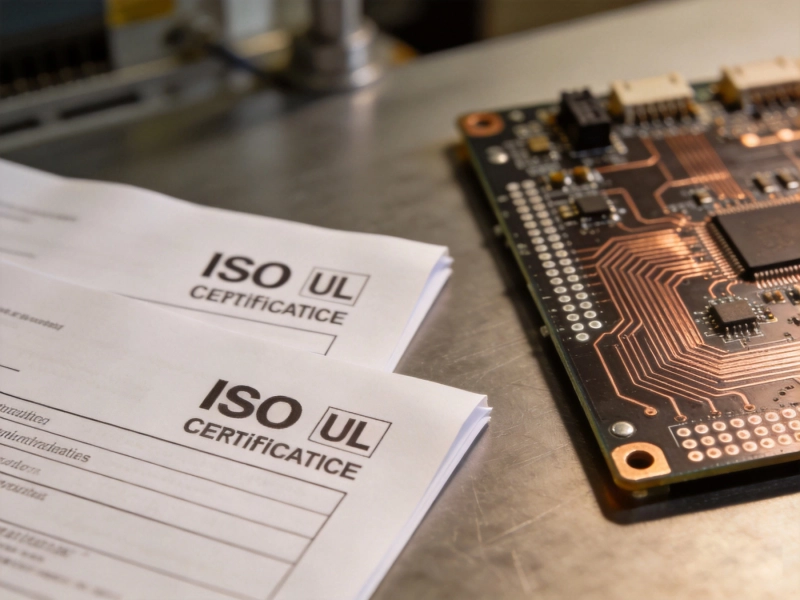
ISO and UL Certifications: What They Mean for Your PCB QualitySeptember/26/2026
How to Specify Bend Radius for Flexible PCB OrderAugust/06/2026

Supply Chain Resilience: Why Diversifying with a China PCB Partner HelpsSeptember/04/2026
How to Verify the Quality of a PCB Prototype Before Mass ProductionOctober/13/2026
Sourcing Metal Core PCBs for Automotive LED HeadlightsJuly/25/2026
How HDI PCBs Enable Slimmer Smartphones and TabletsJune/26/2026
The Hidden Costs of Cheap PCBs: Why Quality MattersJuly/23/2026
High-Voltage Industrial Control Boards: The Case for Heavy CopperJune/29/2026